
Tata Nano EV : Tata Nano EV has become one of the most discussed “what if” stories in India’s EV space, with social media flooded by claims of a 2–3 lakh rupee electric Nano offering 200–400 km range.
In reality, Tata Motors has not announced any official Nano EV for production, but multiple reports, rumours and concepts show how strongly the market wants the iconic people’s car to make a comeback in electric form.
From One-Lakh Car to EV Legend in Waiting
The original Nano was launched in 2008 as the world’s cheapest car, aiming to bring two-wheeler families into the safety of four wheels.
It used a 624 cc petrol engine, basic interiors and ultra‑aggressive cost-cutting to hit a roughly ₹1 lakh ex‑factory price, but sales never matched the hype due to image issues, early quality concerns and rising costs. Production finally ended around 2018.
Even after discontinuation, the idea of a tiny, ultra‑affordable city car stayed powerful. As India’s EV wave picked up, that dream quickly latched onto the Nano nameplate: if any car could become a true “EV for the masses,” enthusiasts reasoned, it would have to be a Nano reborn as a compact, efficient electric hatch.
Conversion Projects and Early Nano EV Experiments
Before rumours of a factory Nano EV exploded, a few conversion specialists and startups had already turned retired Nanos into electric prototypes.
One widely covered example featured a converted Nano with an electric motor and battery pack, used as a proof-of-concept to show how old city cars could get a second life as EVs.
Ratan Tata himself was seen travelling in an Electra EV-converted Nano, sparking headlines that the company’s patriarch still believed in the platform’s possibilities.
These experiments demonstrated that the Nano’s lightweight shell and compact dimensions were suitable for city‑range EV conversions, even if they weren’t designed as EVs from the ground up.
Viral Claims: 250 km Range, 2–3 Lakh Price
Over the last couple of years, the internet has been packed with videos and posts claiming that “Tata Nano EV” or “Tata Nano Electric 2025/2026” had been launched with startling specs—often quoting:
- 200–250 km or even 300+ km range per charge.
- Top speeds of 80–100 kmph.
- Fast‑charging times under one hour.
- Base prices starting from ₹2.5–3.0 lakh ex‑showroom.
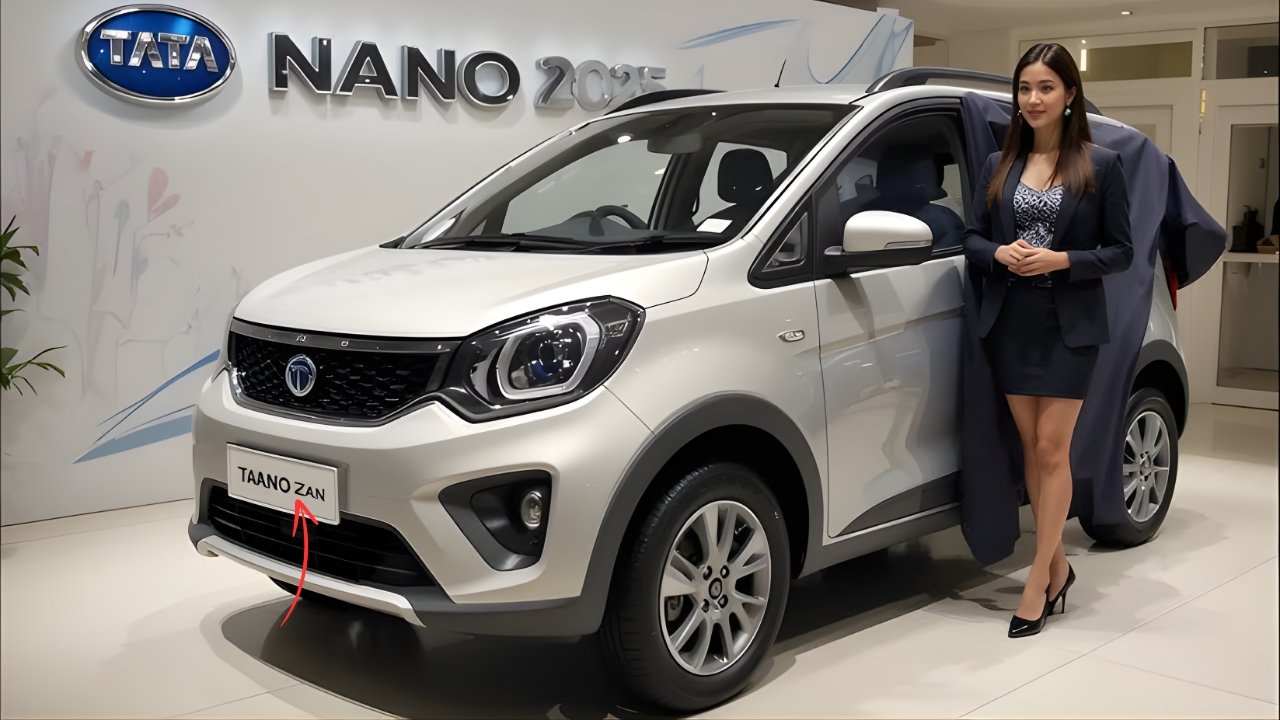
Many of these pieces use AI‑generated images or edited Nano photos with LED lamps and EV badging, then build a full narrative around them: variants, colours, battery capacities and EMI schemes.
However, none of them link to any official Tata Motors product page, official brochure or government homologation documents.
What Reports and Analysts Actually Say
A handful of more cautious write‑ups and analysis pieces explore the Nano EV question in a realistic context. They note:
- Tata Motors is focusing its official EV lineup on models like Nexon EV, Tiago EV, Tigor EV, Punch EV and future dedicated EVs under the Tata.ev umbrella.
- Internal product planning and investment priorities, as reported by mainstream outlets, do not show a confirmed Nano EV project on the immediate roadmap.
- A micro‑EV at an ultra‑low price would only be viable if battery costs fall significantly or if aggressive localisation and government support reduce the cost of cells, electronics and safety hardware.
One detailed article frames the Nano EV idea as a “promise of affordable urban mobility” but ultimately classifies it as speculative, noting that no official confirmation has been issued and that many of the circulating specs are unrealistic given current battery prices.
Practical Challenges to a Real Nano EV
If Tata were to revive the Nano as an EV, it would face several concrete challenges:
- Safety and crash norms: The original Nano platform would require substantial re‑engineering to meet current crash standards and to safely integrate a floor-mounted battery pack.
- Battery cost vs target price: Even small packs (e.g., 15–20 kWh) carry significant costs, making true ₹2–3 lakh EV pricing extremely difficult without heavy subsidies or severe compromises on range and performance.
- Brand perception: The Nano name carries underdog charm but also memories of “cheapest car” stigma; Tata might prefer a fresh name for a future entry EV.
Because of this, several analysts argue that while a small, ultra‑affordable EV may eventually come from Tata, it may not be packaged as a literal “Nano EV” revival, even if it carries similar design cues or positioning.
Why the Nano EV Rumour Refuses to Die
The persistence of Nano EV rumours is driven by a mix of nostalgia, unmet market demand and viral content formats. Millions of Indians still want a city car that is genuinely affordable to buy and cheap to run, and Nano’s story naturally fits that desire in people’s minds. At the same time:
YouTube creators gain views with titles like “Nano EV finally launched” and “World’s cheapest EV from Tata,” even when the videos themselves admit that many details are speculative.
Social media forwards amplify any neatly packaged graphic or voiceover promising impossible combinations of low price and high range, without verifying against official sources.
This feedback loop keeps Nano EV constantly trending, even though there is no product in Tata showrooms by that name.
Tata Nano EV : Idea with Huge Appeal, But Not Official Yet
As of December 2025, there is no officially launched Tata Nano EV in Tata Motors’ portfolio, nor any firm, detailed public announcement that a Nano‑branded EV will arrive in 2026. What exists instead is:
- Real Nano‑to‑EV conversion projects that prove the technical possibility.
- A strong desire among buyers and commentators for a truly affordable EV city car.
- A large volume of rumours and speculative articles turning that desire into click‑friendly “news.”
If Tata does decide to launch a micro‑EV in the coming years, it will likely be revealed through official Tata.ev channels, detailed press releases and clear product pages—those will be the signals to watch.
2026 Chevrolet Bel Air Revival his first look – features is luxury and comfort
Until then, “Tata Nano EV” remains one of India’s most compelling EV what‑ifs: a symbol of how powerful the dream of accessible, electric mobility has become.